Customer Segmentation using Clustering
This project focuses on segmenting customers into different groups based on transaction and demographic data. The goal is to use machine learning techniques like KMeans clustering to identify distinct customer groups, enabling businesses to tailor marketing, sales, and customer service efforts more effectively.
Project Objective
The objective of this project is to segment customers based on their behavior and characteristics, allowing for personalized services and better customer management. The segmentation is achieved using unsupervised learning methods, primarily KMeans clustering.
Steps Involved:
Data Preparation:
- Clean the data by handling missing values and removing outliers.
- Convert categorical data to numerical format using encoding techniques.
- Standardize the features using techniques like StandardScaler.
Model Selection:
- Tested KMeans clustering to identify optimal customer groups.
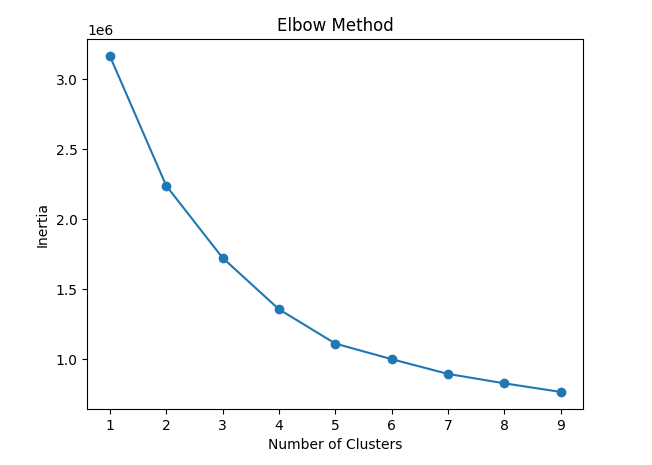
- Determined the number of clusters using the Elbow Method.
Model Training:
- Fit the KMeans model on the customer data and predict the clusters.
- Assigned each customer to a cluster based on their behavior and characteristics.
Evaluation:
- Visualize clusters using dimensionality reduction (e.g., PCA, t-SNE).
- Analyze the distribution of key features across clusters.
Customer Segments (Clusters):
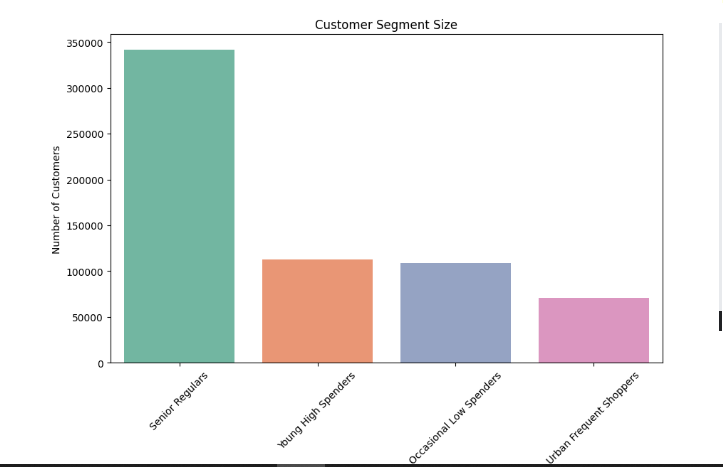
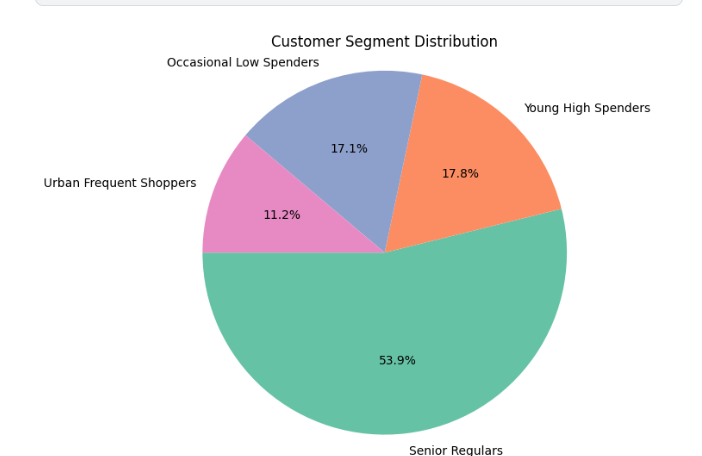
After applying KMeans clustering, we identified four distinct customer segments. Each segment represents a group of customers with similar behaviors and characteristics:
1. Young High Spenders (Cluster 0):
These customers have high account balances and make frequent transactions. They are highly engaged and contribute significantly to the company's revenue.
2. Senior Regulars (Cluster 1):
Customers in this segment have steady account balances and make regular transactions. They are loyal and have a consistent purchasing pattern.
3. Occasional Low Spenders (Cluster 2):
This segment represents customers with low account balances who make infrequent transactions. They require targeted marketing efforts to increase engagement and spending.
4. Urban Frequent Shoppers (Cluster 3):
These customers are highly active in urban areas, making frequent transactions, but their transaction amounts tend to be smaller. They could be influenced by promotions and location-based offers.
Results:
By segmenting customers into these four groups, businesses can create personalized marketing campaigns and improve customer retention strategies. Understanding these customer types helps in tailoring services to meet their needs and increase overall satisfaction.
Images from the Project